Embryonic Fetal Development and Growth
How your baby grows in the first few months
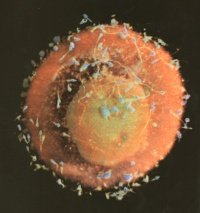
ConceptionMillions of sperm race to fertilize the ovum, but only a few hundred survive the journey, and only one can enter. The sperm and egg join in the fallopian tube to form a new human being. Forty-six chromosomes combine, which pre-determine all of the physical characteristics of this new person. |
 |
|
|
|
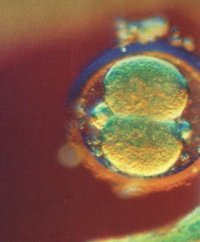
Week 2 of pregnancyThe fertilized egg is no larger than the head of a pin. Still rapidly dividing, the developing embryo, called a zygote at this stage, floats down from the fallopian tube and towards the uterus. Week 3 of pregnancyOnce in the uterus, the developing embryo is called a blastocyst. It searches for a nice place to implant, where it burrows beneath the surface of the uterus eight days after conception. At this point a woman is officially considered pregnant. |
 |
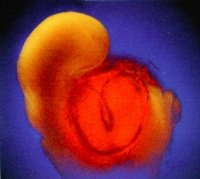
Week 4 of pregnancyThe heart of the embryo is the largest and most prominent feature. The body is soft and transparent. The body is very tiny and barley visible to the naked eye. The embryo produces hormones that stop the mother's menstrual cycle and produce symptoms of early pregnancy. On the 15th day of the life of the embryo, the first nerve cells are formed, which are the foundation of the brain. |
 |
|
Some consider the emergence of brain cells, on the 15th day after fertilization, the point at which human life begins, as the brain is the seat of consciousness. |
|
Week 5 of pregnancyThe embryo is the size of a raisin. The heart has been still until this point, but at 22 days after fertilization the heart muscles contract and being steady, rhythmic beat. The placenta begins functioning. The bones in the skull begin to fuse together. The spine and spinal cord grow faster than the rest of the body at this stage and give the appearance of a tail, which disappears as the child continues to grow. |
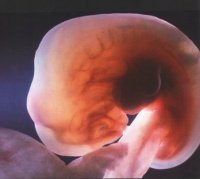 |
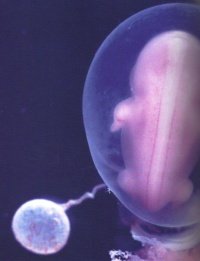
Week 6 of pregnancyAt 28 days the back of the embryo reveals a developing spinal column. Arm and leg buds can be seen. The placenta is delivering essential nutrients to the embryo from the mother. Primitive lungs take shape. The yolk sac (on the left) aids in circulation until the embryo can take over this function internally. |
 |
|
"Years ago, while giving an anesthetic for a ruptured tubal pregnancy (at two months) I was handed what I believed to be the smallest human being ever seen. The embryo sac was intact and transparent. Within the sac was a tiny human male, swimming extremely vigorously in the amnionic fluid, while attached to the wall by the umbilical cord. The tiny human was perfectly developed, with long, tapering fingers, feet and toes. It was almost transparent as regards to the skin, and the delicate arteries and veins were prominent to the ends of the fingers. The baby was extremely alive and did not look at all like the photos and drawings of 'embryos' which I have seen. When the sac was opened, the tiny human immediately lost its life and took on what is accepted as the appearance of an embryo at this stage, blunt extremities, etc." - Paul E. Rockwell, M.D. |
|
Week 7 of pregnancyFacial features are visible, including the mouth and tongue. The eyes are forming and have a retina and lens, but no eyelids yet. The hands resemble little paddles. The major muscle system is developed. The child has its own blood type, distinct from the mother's. The nervous system can register sensations, such as touch, temperature, and pressure. |
 |
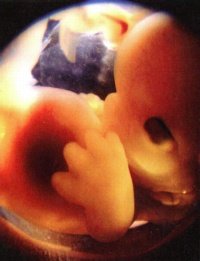
Week 10 of pregnancyAt week 10, the embryonic stage ends and the fetal period begins. The tiny organs have all formed and are starting to function. Muscles in the arm, legs, and chest begin to move and exercise. Twenty tiny baby teeth are forming in the gums. Fingers can be seen forming on the hands, and the development of the feet and toes lag behind. The fetus is approximately an inch in length. |
 |
 Did you know: A woman's pregnancy is counted from the first day of her last menstrual period. This means that at the moment of fertilization, the unborn child is already considered two weeks old by obstetricians.
[source information for fetal photos]
You've now made it through the first trimester, after which the dangers of miscarriage are decreasing every day. Check out our pregnancy videos.
or sign up
Post a comment